
Breaking bad news — Topic Home / Introduction
Breaking bad news
9 pages.
Breaking bad news to a patient is one of the hardest tasks that dental professionals face.
This course guides you through what you need to do as an empathic health care professional, and how to avoid the pitfalls.
Member Feedback on Breaking Bad News
- Very informative and precise about the essential components of breaking bad news
- Course was excellent. I really liked this course
- It was really nice and enlightening.
- I really enjoyed this course. It was concise and easy to understand. I felt that I agreed with everything in the course information and try and treat patients the way it was advised.
- I picked up some great tips which I feel will allow me to interact with patients better.
Participant Feedback Report: Breaking Bad News CPD Module
Participants provided highly positive feedback about the Dentaljuce CPD course "Breaking Bad News," appreciating its clear structure, concise content, and practical relevance.
Key Strengths
Participants consistently highlighted several strengths of the module:
-
Clear and Concise Content: The course was praised for its clear, direct, and easy-to-understand presentation, effectively guiding learners through sensitive topics.
- "Clear. Concise. Useful."
- "Short and to the very practical point."
-
Practical Application and Communication Skills: Participants found the structured communication techniques and language suggestions highly beneficial for managing difficult patient interactions.
- "This course has made me efficient and very well versed in handling bad news."
- "Great course that enhanced my knowledge of how to deliver bad news to patients in my daily work."
-
Empathy and Emotional Support: The emphasis on empathy, active listening, and emotional support was particularly valued, assisting learners in approaching conversations with greater sensitivity and professionalism.
- "Really meaningful course, helps to communicate better in tough situations."
- "The course described the need for empathy—much needed."
Specific Positive Comments
Participants shared numerous appreciative remarks, including:
- "Excellent course, very informative."
- "Really an eye-opener, informative."
- "Very good and detailed."
- "Practical and to the point. Thank you!"
- "Very insightful."
Suggestions for Improvement
Participants provided a few suggestions for further enhancement:
- Incorporating additional simulated scenarios or short videos demonstrating specific examples of dialogue.
- Providing more comprehensive examples and vocabulary lists to assist in real-life application.
Closed-Question Feedback Summary
Participant satisfaction was notably high across key metrics:
- Met Learning Objectives: 98% strongly agree/agree
- Good Quality: 98.1% strongly agree/agree
- Useful & Relevant: 96.6% strongly agree/agree
- Engaging: 95.1% strongly agree/agree
- Pitched at Right Level: 94.7% strongly agree/agree
These ratings strongly affirm the course’s effectiveness, relevance, and high-quality content.
Overall Participant Impression
Overall, participants praised the "Breaking Bad News" course as valuable, informative, and practically essential for dental professionals. Learners felt more equipped with skills and confidence for empathetically delivering difficult news, positively impacting patient care and communication.
Breaking bad news
Welcome
I understand. Do not show this message again.
Breaking bad news
The dental examination

The nature of a dental examination often precludes creating the ideal conditions for breaking bad news immediately. Ideally this will be after you have had time to
- form an opinion of the patient, and their knowledge level
- reflect on what information to give
- decide what supporting written information you should provide
- create an atmosphere and surroundings conducive to a potentially difficult discussion
- include a relative or carer when appropriate to give moral support to the patient
However, if a patient suspects during the examination that you have discovered some “bad news”, they will want an immediate response from you. Trying to defer the discussion, for example by saying that you need test results or a specialist opinion before you can say anything, will inevitably worry the patient.
Accordingly, during the examination it is important not to allow yourself to express worry or convey concern, even if you feel it.
Be sensitive when communicating findings and required treatments to the person who is recording the examination with you. more…
Ideally, your discussion will then take place with you sitting face to face on similar chairs of equal height. This may not be possible in smaller surgeries, where the dental chair should be arranged as well as possible.
If you feel the patient’s relative / carer should be present, you can say, e.g. “we’ve got quite a lot to talk about, so perhaps you would like xxx in to help you remember everything afterwards.”
Breaking bad news
Delivering the news
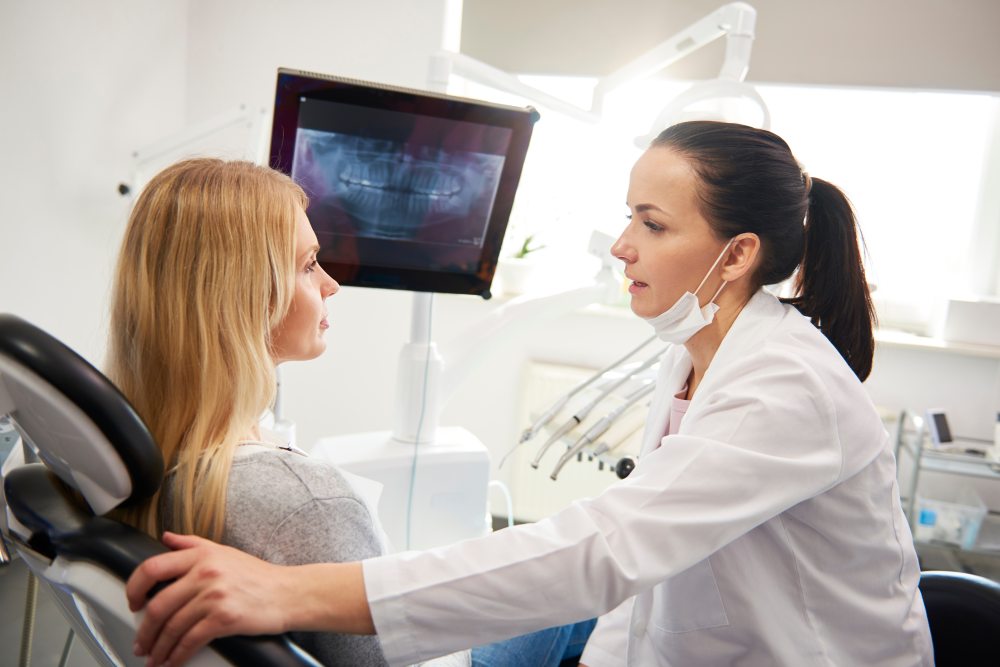
When a patient has reported a problem, start by establishing what the patient is expecting to hear, and how much they know or suspect about their dental health.
Use open questions like “what do you think might be happening here”: this will establish their knowledge level and how concerned they may be about it.
If the bad news is going to be a complete surprise, for example a clearance is needed because of previously undiagnosed periodontal disease, start gently by discussing the condition and finding out what the patient knows about “gum disease”, let them know how it is painless and progressive over many years, and give them time to absorb where the conversation is going. Do not go straight in and tell them they need a clearance.
Practicalities and language
Introduce people who are present, for example co-workers, and make sure the patient accepts their presence.
Use eye contact and appropriate body language.
When delivering the findings, avoid jargon. Use the same language as the patient. Avoid words like “lesion”, “pathology”, “potentially pre-malignant”, which are fairly neutral to professionals but can be very emotive to the public. If the diagnosis is unsure, instead of “lump” say “swelling”.
If referral is needed for a definitive diagnosis, one can emphasise that the referral is just a precaution, or to exclude something serious. However, if you are unable to offer a more likely diagnosis, this will leave the patient wondering what the real reason for the referral is.
For example – if a patient has a small nodular white patch, and of course you genuinely do not know what the degree of dysplasia (if any) is, you can say that these white patches are common, but we always investigate them to be on the safe side, or to ensure they won’t become cancerous in the future.
Breaking bad news
Dealing with emotions

Anger and crying are common reactions to bad news, and with anger it is especially important (though difficult) to understand it as a reaction, and not take it personally.
You should allow the emotions, and acknowledge them empathically without being judgemental.
Do not “steal their grief”. For example, avoid saying that it is really upsetting you to have to tell them this. Phrase it as “I am so sorry to have to tell you this” – a small but important difference.
If a patient becomes angry about a previous dentist, for example who they believe has missed the diagnosis, do not “join in” with blaming the previous dentist. Although this might seem like a strategy to calm the patient down, it usually fuels the anger further and can turn a short term reaction into a longer one. It is best at this stage to let the patient vent a full range of emotions, showing empathy but, at this stage, not judgement.
Breaking bad news
Treatment planning

After the news is delivered and processed, it is important to firmly move on to positive planning for the next steps, and move the patient towards thinking of the immediate practicalities rather than a cloud of vague long term consequences. They should not leave the practice without knowing what the plan is.
Make sure verbal information given to the patient is backed up by written information. Memory for detail can be very poor when faced with bad news.
Let the patient know about any relevant support services. Find out about these now, so you have it to hand should you ever have to deliver news that has severe consequences for health or life.
Records
Ensure that there is a document put into the patients notes that records the information/facts given to the patient at the meeting.
Create time after the patient has left for your practice for structured reflection on the experience, and decide if anything could have been done better.
Breaking bad news
Consequences

If a patient has received, for example, a definitive diagnosis of oral cancer, they will go through a range of emotions, including anger, and will inevitable reflect on every step of their journey to that diagnosis. They may ask for access to their dental records.
If they suspect you have been dishonest with them, for example telling them it you were sure it was nothing to worry about despite recording “probable stage 4 SCC: refer” in your notes, they may initiate a complaint in their emotional state.
Bad news is always by definition upsetting, and although the emotional consequences of honesty can be distressing for the dental professional, it is better in the long run than trying to defer the distress by withholding what you know to be the truth.
Breaking bad news
Exam Pass Notes
Key Takeaways
- Prepare optimally for bad news delivery
- Gauge patient knowledge and expectations first
- Use simple, non-jargon language
- Allow emotional reactions, don't take personally
- Move quickly to practical next steps
- Thoroughly document information given
- Reflect afterward for improvement
- Be as transparent as possible
Overview
- Breaking bad news is one of the hardest tasks for dental professionals
- Bad news can be unexpected or anticipated by patient
- Important to be empathetic - reactions can be unpredictable
The Dental Examination
- Dental exam often precludes ideal bad news delivery conditions immediately
- Need time to reflect, gather information, create environment, include relatives
- If patient suspects during exam, they will want immediate response
- Don't convey concern during exam even if felt
- Be sensitive communicating to assistant - don't cause panic
- Write findings yourself first to reflect before discussing
- Ideal is face-to-face discussion on equal height chairs
- Can include relative/carer for support if appropriate
Delivering the News
- Establish patient's expectations and knowledge first with open questions
- If complete surprise, discuss condition gently, find out their knowledge, give time to absorb
- Use simple language, avoid jargon and emotive words like "lesion"
- Call it cancer if confirmed, avoid words like malignancy/tumour
- Can emphasise precautionary nature of referrals if diagnosis unsure
- Don't give false reassurance - investigate white patches to be safe
Dealing with Emotions
- Expect anger, crying - understand as reaction, don't take personally
- Allow emotions, acknowledge without judgement
- Don't "steal grief" - say "sorry to tell you" not "upsetting to me"
- Don't join in blaming previous dentists
- Let patient fully vent before reassuring
Treatment Planning
- Move to positive next steps, focus on practicalities
- Support verbal information with written information
- Provide info on relevant support services
- Document information given to patient
- Reflect afterward on experience
Consequences
- Patient will experience range of emotions including anger
- May request records if feel misled about seriousness
- Balancing honesty with causing upset is difficult
- Emotional consequences of honesty better long term than hiding truth
Breaking bad news
Self-assessment (optional)
What are some situations where dental professionals might need to break bad news to a patient?
There are many questions in the Dentaljuce pages for you to think about. This is to break up the page so you can maintain your focus and concentration, rather than viewing large blocks of text.
You do not have to fill in any questions, quizzes or MCQs to prove you have spent the time doing CPD, as the time recorder has all the details. The time you spend learning on the Dentaljuce site is the basis for your CPD certificates.
I understand. Do not show this message again.
What should dental professionals avoid conveying during the examination even if they feel it?
What can be done to give the dental professional time to reflect on their findings before discussing them with the patient?
When breaking bad news, how should the dental professional begin the conversation with the patient?
What are some recommendations for dental professionals when using language to deliver bad news?
How can dental professionals emphasise the need for referral while reducing patient anxiety?
What is the ideal seating arrangement for discussing bad news with a patient?
Why is it important for dental professionals to be empathetic when delivering bad news to patients?
What is an important aspect to consider when a patient expresses anger or cries after receiving bad news?
What should be the focus after the news is delivered and processed?
Why is it important to provide written information to the patient along with verbal information?
What should be documented in the patient's notes after the meeting?
Why is it important for dental professionals to be honest with patients about the seriousness of their condition?
How should a dental professional react when a patient becomes angry about a previous dentist's perceived negligence?
Breaking bad news
We very much hope you enjoyed this course and found it interesting or useful. Next you will be invited to record your reflections (a GDC requirement for Enhanced CPD), and give feedback.